
On Eugenics (Part I)
Richard Dawkins, Sydney Sweeney and the (Re)Birth of An Anglo-American Tradition


“The students of heredity, especially, understand all of their subject except their subject…That is, they have studied everything but the question of what they are studying.”
—G. K. Chesterton, Eugenics and Other Evils
I’ve never liked Richard Dawkins. I met him when I was 19 at a literary festival and his face was permanently congealed into a frowning emoji, which wasn’t a great start. Then I heard him give a lecture. It was the usual God-bashing shtick about how religion is something to falsify, explain away and when the autopsy is done, its victims can graduate towards the dimpled skepticism of evolutionary biology with a dollop of psychologising blather to wash everything down. Which is both rude and dumb. What Dawkins glosses over is how the general excess of human experience always tends towards metaphors of some sort. Whether they centre around a bearded man in the sky doesn’t matter because these anxieties will find expression via some medium or other. Dawkins’ empiricism isn’t some fundamental break with those that came before. It’s just more prone to arithmetic.
And arithmetic, much like religion, can lend itself to a lot of bullshit. Take this ridiculous tweet from the 20th of February, 2020, where Dawkins tried to enlighten the world via Twitter that actually, theoretically, eugenics would work. “It’s one thing to deplore eugenics on ideological, political, moral grounds,” he said. “ It’s quite another to conclude that it wouldn’t work in practice. Of course it would. It works for cows, horses, pigs, dogs & roses. Why on earth wouldn’t it work for humans? Facts ignore ideology.”

Well you can probably guess how that went down. Sailing headlong into the 2020 US presidential elections, the internet broke the way it always does, into disparate scraps of driftwood as the world and his wife shouted mutually incomprehensible recriminations. Predictably, the finger-wagging Economist readers leapt to Dawkins’ defence, insisting he was merely making a rhetorical distinction while the liberal arts mob spouted back statistics about the dizzying array of human variation and how it all meant that he was scientifically wrong. But the best response came from a third camp, who trotted out some variation of Why the fuck would you say that?
Fast forward to the summer of 2025 and that question mark didn’t land the way it used to. Eugenics were cool again and not just around Dimes Square. By September, American Eagle’s stock jumped 25% back and another 15% by the end of the year, all courtesy of America’s newest conservative darling, Sydney Sweeney. The now infamous ‘Sydney Sweeney has good Jeans’ campaign enraged the snowflakes and had Sydney tearfully sputtering “I’m a person too, y’all.” Meanwhile,American Eagle’s sales went through the roof.
Cynicism always feels fresh in America because it’s not particularly American. And yet here was an eagle touting mass consumer-brand using an aryan princess as a winking shibboleth for the culture wars, all to sell jeans made in China, Vietnam and Bangladesh. The marketing team behind it all were able to brush it all off as a joke and to their credit, it was incredibly well-timed, drawing a clear line in the sand for anyone still questioning whether the woke bubble hadn’t well and truly popped. The uncanny sibling to Kendall Jenner’s 2017 Pepsi-Protest number, Sydney’s team knew something Jenner’s didn’t, namely, what cancel culture was and that not in spite of, but because of it, bad taste could now sell.

Cut to the present and the full implications of the Trump administration’s embrace of eugenic thought are plain to see. Much like their predecessors from a century back, they harp on about the birthrate, about doing more to support the right kind of families while imposing travel and immigration bans on countries with the wrong sort. They call these people ‘animals’ and ‘illegal monsters.’ It’s true, they don’t go so far as to talk about ‘race suicide’ and aren’t facilitating programs of forced sterilisation. They use medical records in a different way, to try and pinpoint where ‘undesirables’ might live and physically remove them from American soil. Or sometimes, just pull over anyone with the wrong shade of skin regardless of whether they have an American passport.
Things are really bad. You can argue about the extent of it but there’s no pretence of being coy anymore. A slumbering beast has been awoken and it has everything to do with purity and quite a bit with animals too.
***
The term ‘eugenics’ was first coined in 1883 by Francis Galton to describe the ‘science’ of improving racial stock through a heady synthesis of evolutionary theory and animal breeding, all to create supposedly ‘better humans.’ Before the Nazis leaned into its arithmetic upon assuming power in 1933, America used its findings to justify a horrific program of forced sterilisations as early as 1907, where Teddy Roosevelt was a huge advocate as were the would-be do-gooders of his day. Even in ours, Planned Parenthood is probably its most visible legacy, with the Pioneer Foundation and its financing of IQ-obsessed psychology studies like 1994’s The Bell Curve coming a close second. While the field fell into disrepute from the early 1930s onwards and into downright infamy following the Second World War, some of the US programs continued unabated until the 1970s. Over the course of its run, north of 70,000 people were sterilised.
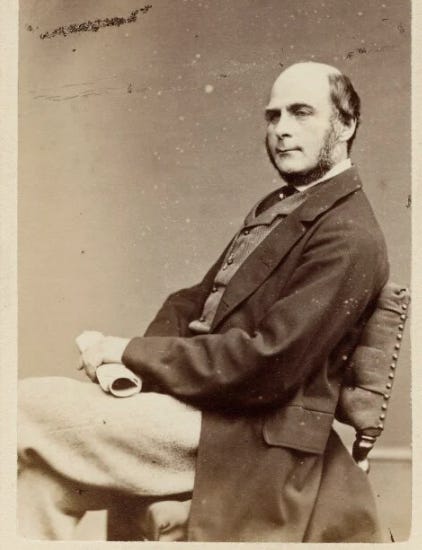
Its precipitous rise in American life can be attributed to lots of different things, but one of them is certainly the rafts of studies published by The Journal of Heredity, which lent the movement a semblance of scientific respectability during its early years. The biggest names in American Eugenics like Charles Davenport, Harry Laughlin, Paul Popenoe and Harry Osbourne all presided over its editorial board at one point or another. Before it switched its name in 1914, that very same publication was known as The American Breeders Magazine, was published by the American Breeders Association that was founded in 1903 and was hellbent on popularising the new science of heredity as it pertained to breeding plants, animals, and of course, humans.
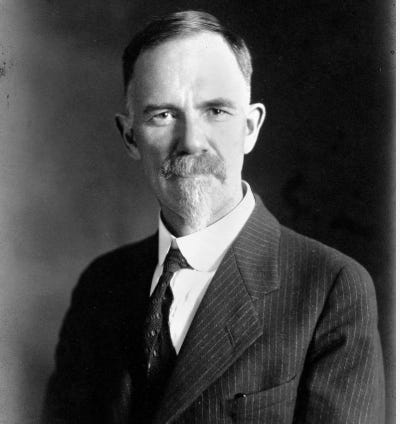
Much like that Pepsi commercial, Dawkins meant well, didn’t have a clue and not just about the surrounding history. He says eugenics would work ‘in practice’ but forgets that the selective breeding between different pedigrees detailed in The Journal of Heredity was accomplished via systematic inbreeding. It was literally Robert Bakewell’s trick when he created pedigree animal breeding in the late 18th century, welcoming livestock specialists from around the world to marvel at the uniformity of type amongst his herds at Dishley. It was literally how most livestock ‘pure’ breeds later emerged with the advent of pedigree books and breed societies around everything from Shorthorn cattle and Leicester sheep to Berkshire and Poland China pigs, all to ensure their increasingly similar (read pure, pedigree bred = more homozygous) mosaic of heritage never strayed too far. And before you could actually see genes, it was the means by which the USDA tracked their effects and revolutionised animal husbandry once again by introducing population genetics to the mix.
In many ways, that comes to us courtesy of Sewell Wright and his protegé, Jay Lush (another swine geneticist), the father of modern animal breeding. The central unit in question? The letter F, otherwise known as the inbreeding coefficient. Given this was Sewell Wright’s pathbreaking contribution to biology and Wright is Richard Dawkins ’ self-described favourite biologist, Dawkins should really know better. Because in human terms, inbreeding is what we call incest.
The commentariat are shy to point towards cultural universals today but the surrounding taboo is the one thing that disparate human communities seem to share. I’m not talking about with cousins but the definitive article, sexual relations between parent and child, grandparent and child and sibling to sibling. The eugenics camp certainly tried to denature the taboo’s grip, whether it was Galton banging on about its ‘immaterial considerations’ while citing Athens and Rome in 1906 or the ABA’s Alexander Graham Bell, the inventor of the telephone, rhapsodising about the joys of consanguinous marriage at The American Breeder’s Association’s meetings two years later. But that was the one part of their program that consistently didn’t go down well. Americans and Brits alike weren’t fond of the notion of breeding their children like animals.
Which is all to say that what Dawkins was tweeting about is indeed theoretically possible. If you put a gun to most people’s heads.
***
To be fair, this blindspot isn’t totally his fault. A lot of historians agree that eugenics is an offshoot of race science but are less comfortable when talking about how animal husbandry influenced understandings of both because many want to (understandably) jettison race as a scientific concept. Linking the emergence of animal taxonomies and breeds, appellations which most people still use and accept, with human ones that we’d rather get rid of makes things tricky. Often, that’s made their writings on the subject annoyingly pedantic or not pedantic enough. The former reads like litigation, which gets boring while the latter sees scholars tie themselves into knots by trotting out Foucault, Deleuze, some of his Rhizomes and all manner of other semiotic crutches to talk about dynamics that are a contorted mess but no less discernible for being so (there are some big exceptions, notably the fabulous work of Gabriel N. Rosenberg). But they needn’t do so — and if we follow our pigs through the hall of mirrors, something of a path emerges.
In my last post about pork in America, I mentioned another eerily familiar spectre, that of a trade war between Europe and the United States that was ignited by allegations around tainted US pork. In response, the USDA founded the Bureau of Animal Inspections which would later become the Animal Husbandry Office and at the turn of the century, it was allocated a mass of funds for agricultural research projects. What began as an investigation into the fecundity of the Poland China Swine in 1904 soon dovetailed into a much larger research drive that by 1910, found itself a platform with the newly created of The American Breeders Magazine. Its first President was none other than James Wilson, the head of the USDA.
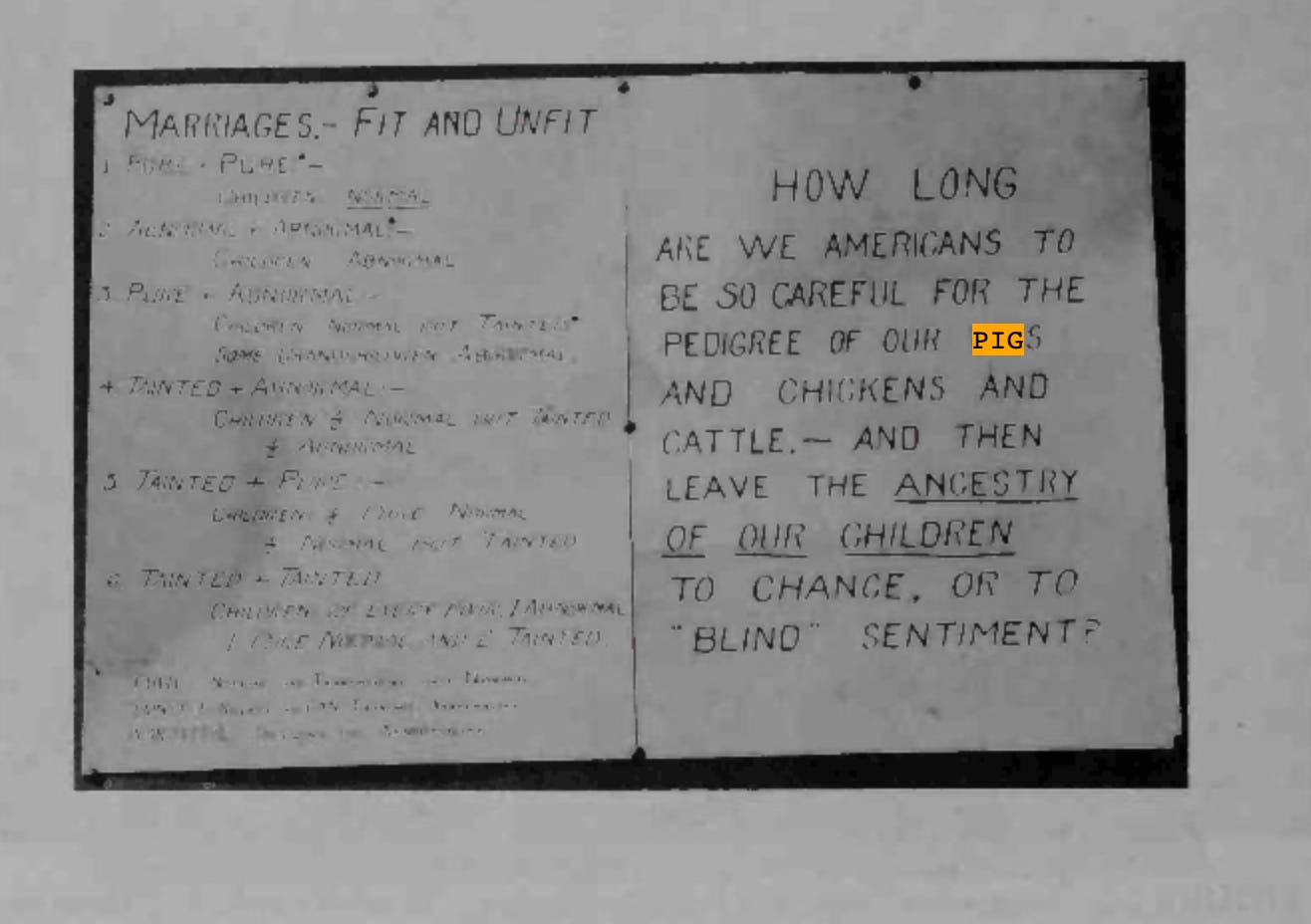
The simple fact is that early 20th-century America was obsessed with the concept of purity, heredity and how both related to animals and humans. You can litigate the fine print but there just was enormous cross-pollination between agriculture and the eugenics movement in both the ivory tower and the popular imagination. All too often, the latter varnished its credentials by way of the former, spouting bilious screeds about biological truths observed in the animal kingdom, cold-hearted rural pragmatism and the dangers of race suicide via mass immigration and intermarriage/miscegenation. Ironically that traffic — alongside the vocal opposition of storied intellectuals like W.E.B. Dubois, Franz Boas and of course, the Catholic Church — would later prove to be eugenics’ undoing in the scientific arena.
By welcoming population genetics into the fold, they undermined the notion that pure breeds somehow performed better as well as the coherence of racial types and how they corresponded to behaviours, ideas of intelligence and other characteristics. It’s a complicated story but there are through lines that we can and should draw, not least because of what’s happening right now. And while the current administration’s obsession with eugenic rhetoric is both similar and very different to a century ago, knowing the particulars might help us call a spade a spade. We should, because there is a very simple word for when masked men with semiautomatic weapons are kidnapping pedestrians off American streets in the name of a government mandate.